How to Choose a Dip Tray for Shabbos and Entertaining
How to Choose a Dip Tray for Shabbos and Entertaining
A dip tray is a serving tray with separate sections or compartments designed to hold individual dips, sauces, and condiments side by side. ZStander makes two lucite dip trays for the Shabbos table: a rotating lazy susan model with five compartments and a stationary 3-section tray for a more compact setup. Both are crystal-clear acrylic, so they disappear on the table and let the food do the talking.
Which one belongs on your table depends on how many guests you typically serve, what dips you like to put out, and how much counter space you have for storage. Here is what to consider.
What Is the Difference Between a Rotating and Stationary Dip Tray?
The two main styles of dip tray are rotating (lazy susan) and stationary (fixed sections). They solve different problems at the table.
A rotating lazy susan dip tray spins so every guest can reach every dip without standing up or asking someone to pass it. ZStander's version measures 13 x 3.5 inches, holds five round dip containers, and comes with five lucite dip spoons. The raised cylinder around each compartment hides the container labels, so your store-bought hummus looks like it came from a caterer. You can also get it engraved in Hebrew or English for a personalized touch.
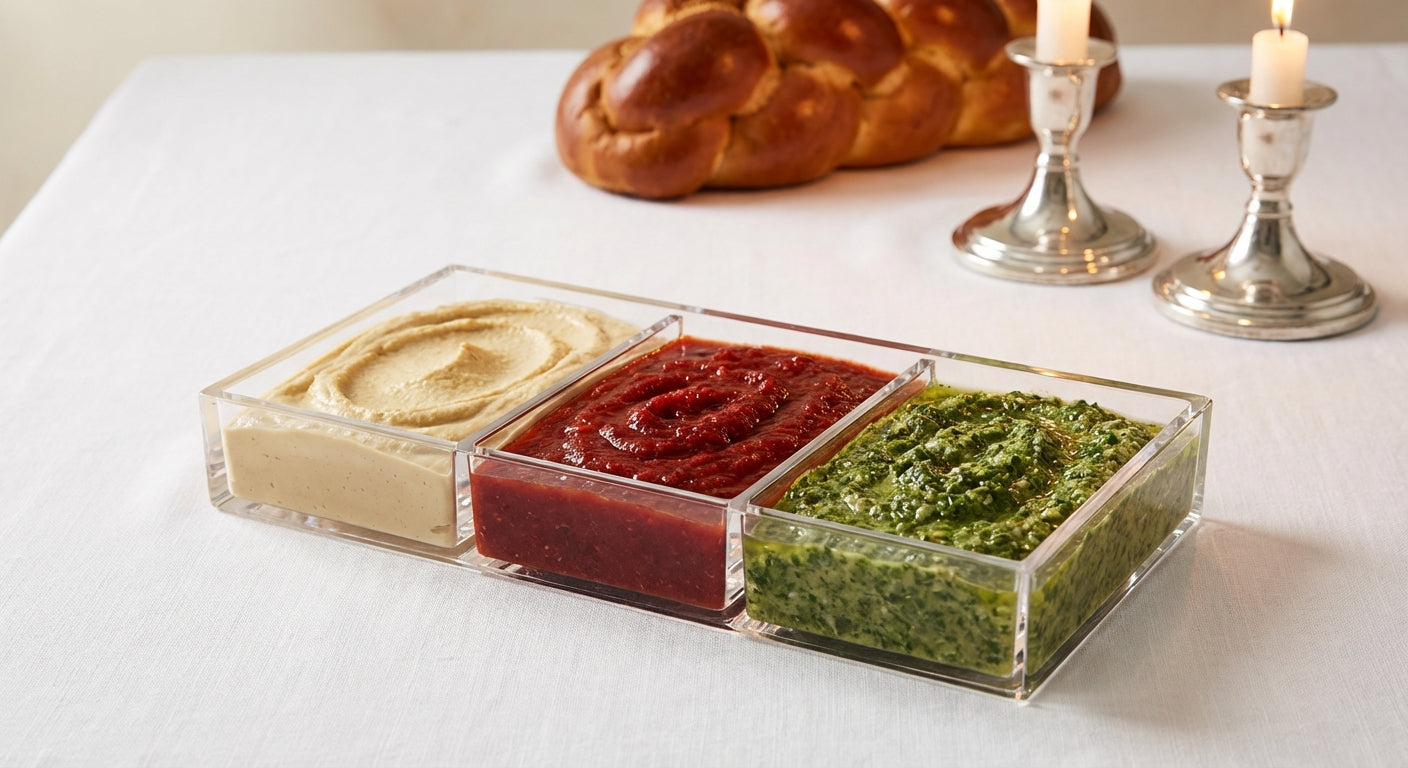
A stationary 3-section dip tray is a single flat piece with three built-in compartments. ZStander's version is 16 x 6 x 1.75 inches, which makes it long and narrow. It sits well along the center of the table or on a side buffet. The sections are molded directly into the lucite base, so there are no removable parts to lose. It stacks flat for storage, which matters if your cabinet space is limited.
In short: the lazy susan is for bigger spreads where everyone needs access, and the 3-section tray is for smaller tables or when you want a clean, minimal look with just a few dips.
How Do You Set Up a Dip Tray for Shabbos?
For a Shabbos table, you want variety without overdoing it. Three to five dips is the sweet spot for most families.
A classic Shabbos dip spread includes hummus, matbucha, and tehina. That combination covers creamy, spicy, and savory, and it works with challah, pita, or vegetables. If you have five compartments (like the lazy susan), add babaganoush and a simple Israeli salad or pickled vegetables to round things out.
Color matters more than people realize. A tray full of beige dips looks flat. Put the red matbucha between the lighter hummus and tehina so the colors alternate. If you are using the 3-section tray, pick three dips with three distinct colors. A green zhug or herb dip next to a white tehina and a red pepper dip creates a visual spread that looks intentional.
One practical tip: if you are using store-bought dips in their original containers, the lazy susan is the better choice. The compartments are sized for standard round dip containers, and the cylinder wall hides the labels. With the 3-section tray, you would transfer the dips directly into the tray sections, which gives a cleaner look but means washing the tray afterward.
For Yom Tov meals with more guests, you can use both trays together. Put the lazy susan at the center of the main table with five dips, and place the 3-section tray on a side table or buffet with three additional options like chumus masabacha, beet dip, or labneh.
How Do You Choose the Right Size Dip Tray?
Size depends on two things: how many people are eating and how much table space you have.
The 3-section tray at 16 x 6 inches is long and narrow. It works well for 2 to 6 guests, and it fits on most standard dining tables alongside other dishes without crowding the place settings. The three sections hold enough for a small family Shabbos or an intimate dinner.
The lazy susan at 13 inches across is round, so it takes up more width but serves more people. Five compartments with dip spoons means 6 to 12 guests can serve themselves comfortably, especially since it rotates. For a large Shabbos table with 10 or more guests, a rotating tray keeps things moving so nobody has to reach across the table.
Storage is worth thinking about too. The 3-section tray stacks flat and slides into a cabinet shelf easily. The lazy susan has more depth because of the rotating base and the compartment walls, so it needs a bit more storage room. If you host frequently, you probably have the space. If the tray comes out only for Yom Tov, the slimmer 3-section model stores more easily between uses.
Which Dip Tray Is Right for You?
If you regularly host 6 or more people and like putting out a full spread, the Lazy Susan Dip Tray with its five compartments and included spoons is the more practical choice. If your Shabbos meals are smaller or you prefer a streamlined table with just a few dips, the Lucite 3 Dip Tray keeps things simple and stacks away in seconds.
Both trays are part of ZStander's Tabletop collection, which includes matching lucite serving pieces for a coordinated table setting.